

Synthetic Spin Ice (ASI) has emerged as an enchanting platform for finding out collective behaviour in interacting nanomagnets, with potential functions starting from magnetic gadgets to neuromorphic computing. On this article, Arthur Penty, Johannes H. Jensen, Ida Breivik, Anders Strømberg, Erik Folven, and Gunnar Tufte exhibit how a cellular magnetic construction — a “snake” glider — may be created and exactly managed inside a nanomagnetic metamaterial.
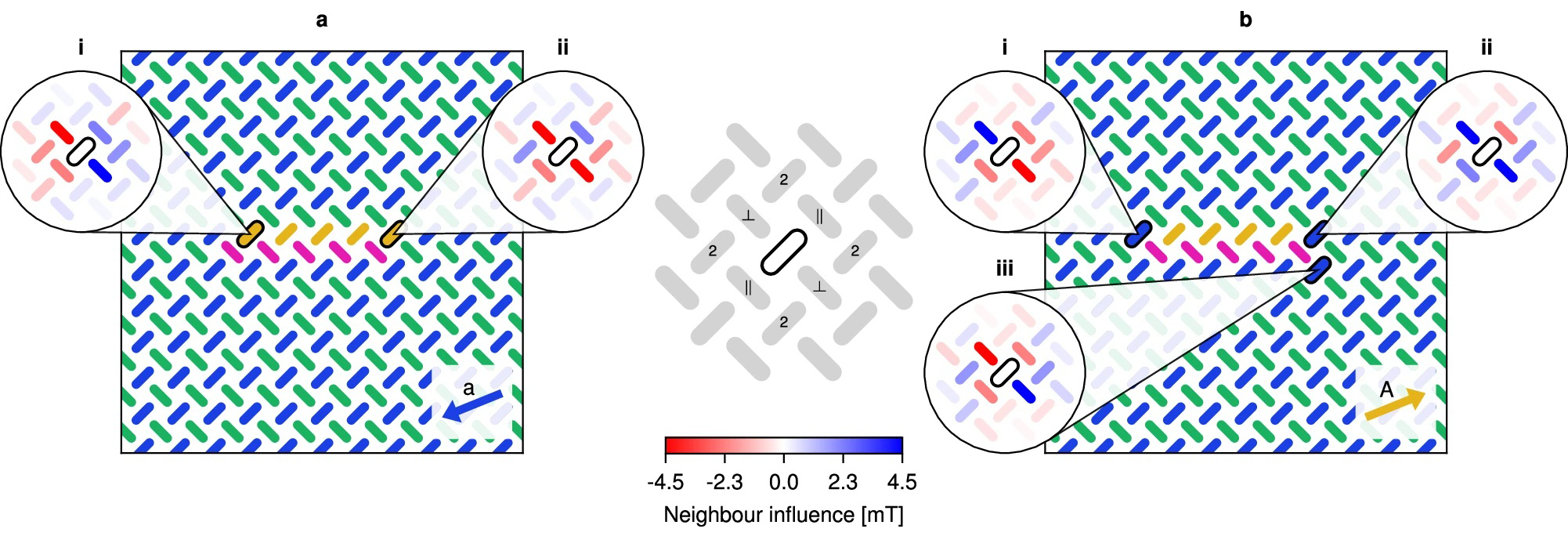
Impressed by the idea of gliders in Mobile Automata, the researchers use an evolutionary algorithm to find a easy shifting construction inside a pinwheel Synthetic Spin Ice system. The ensuing snake can transfer via the nanomagnetic array below a world magnetic-field protocol, permitting managed manipulation of magnetic textures on a scale of roughly 100 nm.
Synthetic Spin Ice as a Platform for Info Processing
Synthetic Spin Ice consists of interacting nanomagnets organized in a two-dimensional lattice. These nanoscale magnetic components can exhibit collective states and emergent behaviour, making ASI engaging for exploring unconventional approaches to info processing.
A key problem is integrating info transformation, transmission, and storage into the identical bodily system. The snake glider launched on this article addresses this problem by offering a controllable magnetic construction that may transfer via the ASI lattice whereas retaining its performance.
The researchers exhibit that the snake can transfer both left or proper relying on its orientation. Its movement is managed via a sequence of in-plane magnetic fields, whereas simulations and experiments are used to research the mechanism accountable for the glider’s motion and its robustness towards dysfunction.
NanoWorld MFMR for Magnetic Drive Microscopy
Experimental investigation of the nanomagnetic constructions was carried out utilizing NanoWorld POINTPROBE MFMR, a magnetic drive microscopy AFM probe designed for magnetic imaging.
The NanoWorld MFMR was used for each writing the preliminary magnetic state and imaging the ensuing magnetic constructions. To initialise the snake, the MFM probe was used to write down an roughly 1 µm magnetic line within the pinwheel Synthetic Spin Ice whereas a ten mT bias area was utilized. The writing course of was carried out with the MFM probe in touch with the pattern at a scan pace of 55 µm/s.
Following magnetic-field-driven evolution of the construction, the researchers used MFM to picture the magnetic state after every utilized area. Imaging was carried out at remanence utilizing a elevate top between 55 and 60 nm and scan speeds between 50 and 55 µm/s. All experiments have been performed at room temperature.
These measurements allowed the researchers to straight observe how the magnetic texture developed because the snake moved via the nanomagnetic array.
Imaging a Controllable Magnetic Texture
The experimental MFM outcomes present a direct view of the magnetic states underlying the glider behaviour. By repeatedly making use of the sector protocol and imaging the ensuing configurations, the researchers may monitor the motion of particular person snakes and examine how their construction responds to the magnetic setting.
The experiments additionally demonstrated the robustness of the idea. A number of snakes could possibly be initialised inside the similar Synthetic Spin Ice array whereas sustaining adequate separation to keep away from undesirable interactions. The researchers additional investigated how fabrication dysfunction impacts the motion of the gliders, discovering proof of self-correction and swish degradation earlier than movement ultimately breaks down.
The mixture of experimental MFM imaging and micromagnetic simulations offers an in depth image of the mechanism behind the snake’s motion. This makes the strategy significantly fascinating for finding out how native magnetic interactions may be harnessed to supply managed, collective behaviour.
From Magnetic Gliders to Neuromorphic Computing
The snake glider offers greater than a visually compelling magnetic construction. As a result of its place and motion may be managed, it will probably act as a bodily service of data inside the Synthetic Spin Ice substrate.
The researchers exhibit how the glider can contribute to info transmission, storage, and transformation, doubtlessly permitting these features to be built-in right into a single magnetic materials. Such ideas may contribute to the event of ultra-low-power computing architectures based mostly on nanoscale magnetic states moderately than standard digital switching.
For this sort of analysis, high-quality MFM probes are
important for resolving and manipulating nanoscale magnetic constructions. The NanoWorld POINTPROBE MFMR offers a devoted answer for magnetic drive microscopy, enabling each magnetic writing and high-resolution imaging of nanomagnetic techniques.
The work by Penty and co-authors demonstrates how MFM can do greater than merely characterise magnetic supplies: it will probably develop into an experimental software for exploring programmable magnetic textures, emergent behaviour, and new approaches to info processing.
Full quotation:
Penty, A.; Jensen, J. H.; Breivik, I.; Strømberg, A.; Folven, E.; Tufte, G.
Controllable gliders in a nanomagnetic metamaterial.
Nature Communications 2025, 16, 7500.
DOI: 10.1038/s41467-025-62515-1
License: CC BY 4.0