


As of April 2025, there are 1.5+ billion internet options in complete, and of those, fewer than 200 million are energetic.
It takes customers solely 50 milliseconds to kind an impression of a website. And 76% of customers are on an internet site if it allows them to simply find what they’re in search of.
Nonetheless, when launching an internet software, many focus solely on pace to market and preliminary options.
However when customers start to extend and calls for multiply, efficiency points begin to present: pages load slowly, methods change into unresponsive throughout peak use, or creating new options turns into agonizingly sluggish.
Any try to unravel issues by buying extra highly effective infrastructure helps just for a short while, and efficiency points are coming again time and again.
That’s the place scalability enters the image. A scalable internet app isn’t merely created to satisfy present calls for — it’s designed with tomorrow in thoughts.
Understanding Scalability in Internet Functions
Scalability is the flexibility of an internet software to tolerate extra customers, knowledge, and requests with out breaking down or shedding efficiency.
But it surely’s not merely about surviving site visitors spikes like Black Friday purchasing or going-viral occasions. It’s about growing methods that adapt as demand grows, so customers see the identical speedy, constant efficiency whether or not 100 or 10 million people are related.
There are two common methods to scale:
- Vertical scaling (scaling up): Vertical sort means scaling one server by including energy, e.g., CPU, RAM, or storage. It usually works properly within the brief time period, however shortly hits bodily limits and might change into dear.
- Horizontal scaling (scaling out): Horizontal scaling entails including extra servers and splitting the load between them. With load balancing and distributed structure, this methodology is much extra versatile and is the default methodology of alternative for apps that anticipate excessive development (although it wants correct structure design of the app, to help balancing with out knowledge corruption and loss).
True scalability, nonetheless, combines each approaches and implies designing a system that isn’t reliant on a single level of failure, although that side relates extra to reliability than to scalability itself.
Benefits of Scalable Platform Improvement
Why take into consideration scalability early? Round 72% of small companies have an internet site as an internet presence of their enterprise. And the payoff can get greater as an app grows.
To start with, a scalable app maintains a excessive load. Excessive efficiency is likely one of the expectations customers have for extremely loaded methods, and that is definitely true for the online.
A scalable app retains functioning faultlessly even with many customers engaged on it concurrently. With correct configuration, furthermore, it is ready to cater to customers globally, offering them with quick and reliable entry no matter their location.
Scalability all the time means resource-efficiency. As a substitute of paying for greater than you eat, you solely scale up assets when there’s excessive site visitors, which helps handle and management bills.
Additionally, an adjustable system is normally extra reliable and safe. It eliminates downtime or knowledge issues which might be prone to come up when apps are overloaded.
This isn’t a direct results of dealing with excessive hundreds, however quite a consequence of stable system structure and well-implemented safety patterns. Such methods reduce downtime and forestall knowledge points which may happen when functions face heavy site visitors.
Subsequent, customers will expertise sooner loading instances as properly. Through the use of caching, CDNs, and extra servers, the app stays fast even underneath heavy use. Nonetheless, this comes at a value — deployment and upkeep change into extra advanced because the system scales.
For a growth crew, scalability permits the app to be simply enhanced sooner or later. New options might be added, bugs might be repaired, or new companies might be built-in with out heavy slowdowns or disruptions.
Nonetheless, constructing a scalable software normally requires a extra skilled crew in comparison with growing a easy monolithic app.
Finally, scalability means a greater expertise for customers and fewer complications for builders. It typically offers an app that’s quick, secure, and capable of scale up because the enterprise expands.
With out cautious design, nevertheless, it could find yourself combining the drawbacks of each monolithic and poorly scaled methods, with out delivering their supposed advantages.
Constructing Blocks of a Scalable Structure
Sturdy structure and system design are the muse of any software program software that plans to develop with out slowing down or falling aside. By understanding and implementing the best constructing blocks, you may assure your software program resolution stays ready for future growth.
Visitors Administration
Load balancers divide incoming site visitors between a number of servers in order that no single one will get overloaded. When one server fails, requests are routinely rerouted to take care of stability and uptime.
When designing site visitors administration for scalable methods, it’s essential to maintain a number of factors in thoughts:
- Particular person requests are remoted, so every both completes shortly or is queued till assets can be found.
- Requests that should go by a number of companies needs to be tracked utilizing a single identifier to make sure consistency throughout the system.
- Safety context must be carried throughout all microservices and validated on the API gateway earlier than processing begins.
- Some companies could also be quickly unavailable, and the system ought to deal with such instances gracefully.
- Community latency is inevitable and needs to be accounted for in design and monitoring.
Caching Technique
Caching reduces the load on the database and hastens response instances. In-memory caches present fast entry to ceaselessly used knowledge, distributed caches enable a number of servers to share knowledge, and CDNs retailer static content material, corresponding to pictures or movies, nearer to customers for sooner supply.
However when implementing caching, a number of factors needs to be thought of:
- Cache invalidation is likely one of the most difficult issues in IT.
- Preserve static content material separate from dynamic or working knowledge.
- At all times set a TTL (time-to-live) for cached gadgets to keep away from serving outdated knowledge.
- Retailer knowledge in a manner that permits the commonest operations to be carried out in fixed time (O(1)) every time doable.
- Take community latency and throughput into consideration, as these can have an effect on cache efficiency.
Optimized Databases
Databases should rationally handle massive volumes of knowledge. For this function, you should utilize sharding (to separate the database into smaller, extra manageable items), replication (to repeat knowledge throughout a number of servers to extend entry pace), and indexing (to rearrange knowledge in order that queries can discover info sooner).
Some essential concerns embody:
- Use indexes judiciously — solely the place they’re wanted.
- Keep away from creating overly massive indexes; an index mustn’t exceed the dimensions of the information it covers.
- Use partitions when applicable to correctly handle massive tables.
- Keep in mind that shards should not the identical as partitions; knowledge have to be distributed thoughtfully throughout shards.
- Keep away from storing quickly rising knowledge, corresponding to logs, in the primary database.
- Don’t put every part right into a single database just because it’s doable; use options like ELK for logs or NoSQL databases the place appropriate.
- Preserve essential monetary or transactional knowledge in a relational database every time doable.
Modular Providers (Microservices)
Breaking down an software into smaller, separate companies, corresponding to funds, person accounts, or search, permits every to scale by itself or introduce options or updates independently with out affecting the complete system.
The most important concerns when designing microservices embody:
- Every service ought to observe the one accountability precept.
- Implement clear monitoring and logging to take care of visibility throughout companies.
- Use ACID transactions every time doable, as eventual consistency can introduce complexity.
- Contemplate service locators, message buses, or queues to coordinate communication between companies.
- Be cautious with retry mechanisms, as extreme retries can create cascading failures or duplicate operations.
Background Processing
All time-consuming duties, corresponding to sending emails, processing funds, or producing experiences, should run within the background to maintain user-facing operations responsive and effectively deal with heavy workloads.
When implementing background processing, it’s essential to contemplate:
- Assist sleek cancellation of duties when wanted.
- Use process queues and employee swimming pools with dynamic allocation to deal with site visitors spikes.
- Plan for retries and failure dealing with to keep away from misplaced or inconsistent work.
- Make sure the queue supervisor is just not a single level of failure to take care of system reliability.
Content material Supply Networks (CDNs)
CDNs cache static assets (pictures, scripts, and movies) on servers around the globe, permitting customers to entry them from the closest location for sooner load instances.
Key concerns when utilizing CDNs embody:
- Make sure that static content material is really static and appropriately configured, together with correct cache lifetimes.
- If dynamic content material is cached on the CDN degree, rigorously outline safety entry guidelines and TTL settings to forestall unauthorized entry or stale knowledge.
- Use CDNs for DDoS safety, including an additional layer of safety for the applying.
Safety and Entry Management
An API gateway centralizes authentication, authorization, and entry administration, in addition to secures the system and makes it less complicated to regulate who has entry to what because the app grows.
Some concerns for designing safety embody:
- Use a traditional user-role-permission mannequin when relevant.
- Outline the safety context on the very starting of the processing pipeline.
- Make the safety context out there throughout all companies to make sure constant checks all through the system.
- Carry out safety checks as early as doable, ranging from the API gateway.
- Use present safety options, corresponding to Keycloak, when applicable to simplify implementation and upkeep.
Methods to Construct Extremely Scalable Internet Functions
In scalable internet software growth, each element issues, and we must always begin with the essential and well-known practices. This manner, preempt extra advanced approaches with easy practices that form your software’s structure and efficiency from the beginning.
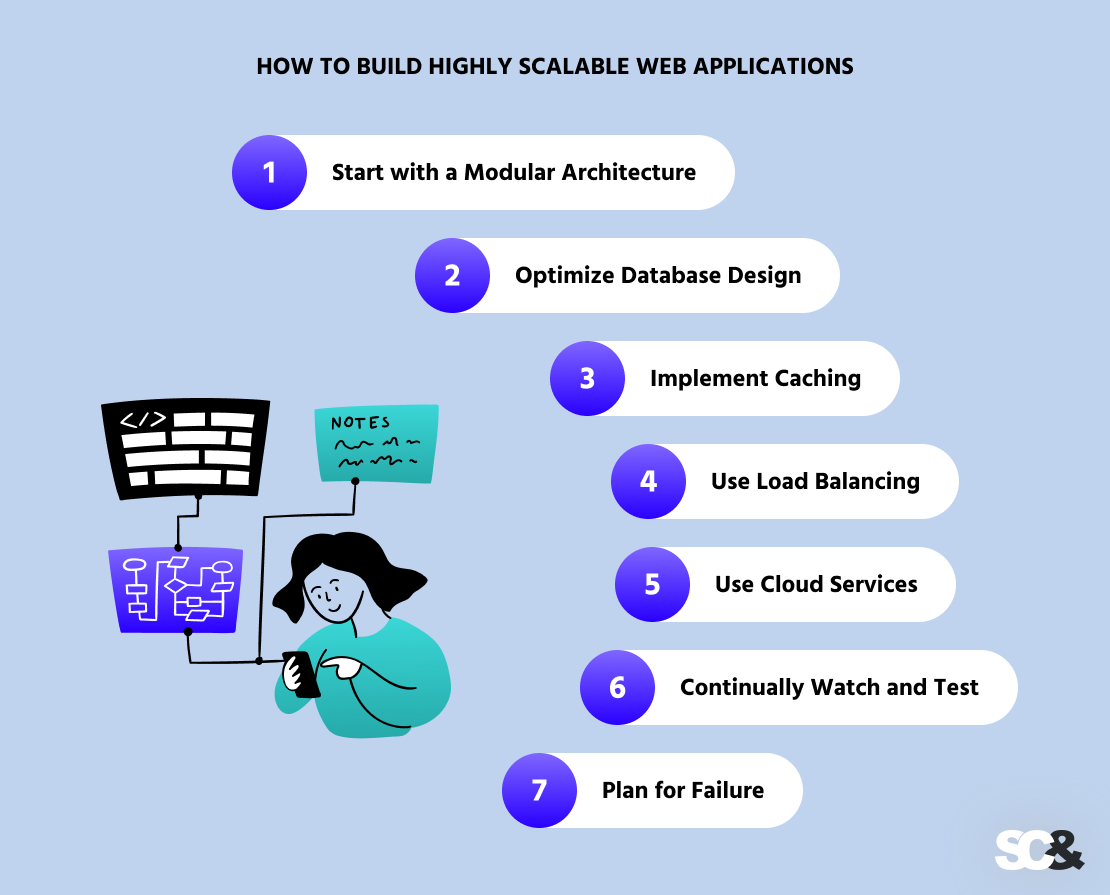
When these are in place, you may transfer on to extra superior strategies to deal with large-scale, real-world workloads.
Begin with a Modular Structure
Architect and design your software so that each side, corresponding to authentication, funds, or reporting, might be independently developed, up to date, or expanded. This technique avoids the buildup of monolithic structure the place one tweak dangers unbalancing the complete system.
Optimize Database Design
Select the best sort of database in your workload: relational (SQL) for structured knowledge and strict consistency, or NoSQL for adaptability and scalability. Take note of question optimization, indexing, and schema design to forestall bottlenecks when your knowledge grows.
Implement Caching
Use in-memory knowledge shops like Redis or Memcached to keep away from retrieving the identical knowledge time and again from the database. Correct caching reduces latency and hastens person expertise, in addition to lowers infrastructure prices.
Use Load Balancing
Divide incoming requests throughout a number of servers to keep away from overloading a single machine. Load balancers assure higher efficiency and enhance fault tolerance in case of sudden site visitors spikes.
Use Cloud Providers
Fashionable cloud platforms (AWS, Azure, or Google Cloud) present instruments for auto-scaling, managed databases, and even serverless computing. Utilizing these companies lets you scale up or down whereas nonetheless having simple infrastructure administration.
Frequently Watch and Check
Monitor efficiency metrics, run stress exams, and simulate peak site visitors to detect weak spots. Steady monitoring helps you act earlier than your customers discover poor efficiency.
Plan for Failure
Programs do break, and it’s inevitable. By designing for sleek degradation and redundancy, you may make sure that your program continues to run even when some side of it fails.
Key Practices for Constructing Extremely Scalable Internet Functions
Other than the muse ideas, extremely scalable internet functions require concrete technical practices that immediately have an effect on how the system behaves underneath excessive hundreds.
Asynchronous Processing of Requests
Don’t let long-running operations block person interactions. Offload duties to background employees utilizing thread swimming pools, message queues (RabbitMQ, Kafka), or process schedulers.
Horizontal Scalability
Scale out, not up. As a substitute of counting on one highly effective server, unfold requests throughout a number of nodes in a cluster. Load balancers handle site visitors distribution and enhance fault tolerance, so if one node is down, others can take over.
Correct Cache Ranges Design
Caching is not only one in-memory repository. Use multi-layered cache strategies:
- Inner caches inside companies for fast entry to ceaselessly used knowledge.
- Shared/widespread caches for distributed environments.
- Cache invalidation methods to maintain knowledge recent and keep away from serving outdated outcomes.
Clear Authorization & API Gateway
Persistently handle authentication and authorization throughout companies. An API gateway provides a layer of safety and simplifies routing, charge limiting, and permission checks with out complicating software logic.
Deployment Finest Practices
Use container orchestration instruments like Kubernetes to handle clusters, deal with rollouts, and scale companies routinely. Containerization proves your software can run unfailingly throughout environments.
Monitoring and Logs
Scalability means you may see what you’re doing as methods develop. Centralized logging, dwell monitoring, and alerting allow you to establish bottlenecks and keep away from downtime earlier than it hits finish customers.
Backup and Restoration
Knowledge is the lifeblood of your software. Implement automated backup methods, use replication for redundancy, and check restoration processes commonly. It’s going to present enterprise continuity even within the case of {hardware} failure or cyber assaults.
Prime Frameworks for Scalable Functions
Choosing the right framework is likely one of the most crucial steps in constructing a scalable internet software. A framework offers builders pre-built instruments and construction in order that they don’t must reinvent the wheel for themselves.
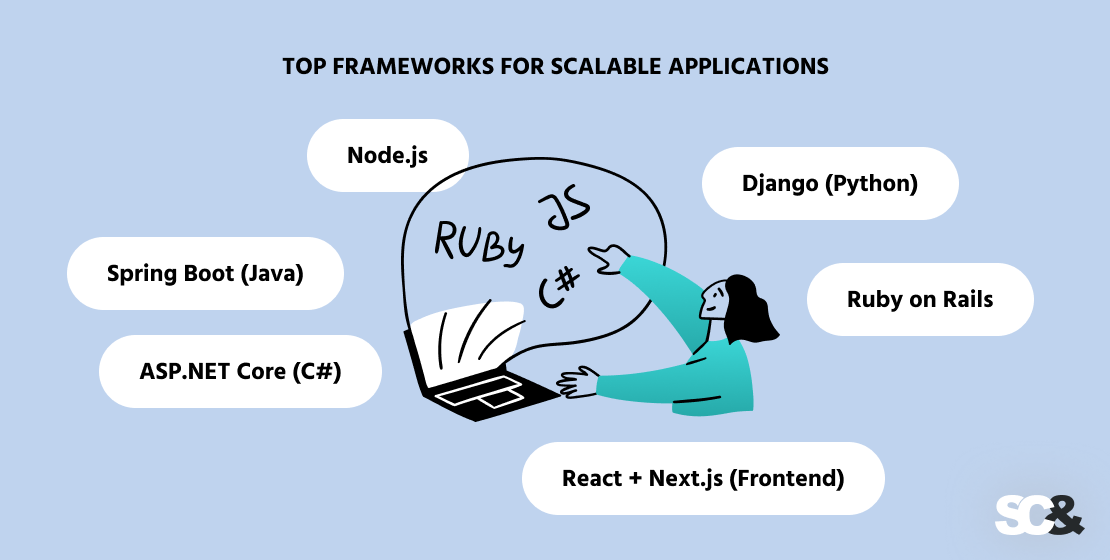
Spring Boot (Java)
Spring Boot simplifies the event of enormous Java functions constructed with microservices. It’s typically utilized in enterprise environments the place efficiency, reliability, and scalability are important, corresponding to banks and e-commerce corporations.
ASP.NET Core (C#)
ASP.NET Core is Microsoft’s open-source framework for creating high-performance functions. It really works throughout totally different platforms and is especially well-suited for enterprise initiatives.
Node.js
Node.js is constructed to course of quite a few requests concurrently. As a consequence of its event-driven framework, Node.js is finest fitted to real-time functions like chats, video games, and streaming web sites. Netflix and LinkedIn are simply two of the quite a few corporations that make use of Node.js to cater to tens of millions of customers and not using a efficiency hit.
Django (Python)
Django is a Python-based framework that features built-in instruments for safety, database administration, and scaling, and permits builders to shortly create secure and safe functions.
Ruby on Rails
Rails is thought for its pace of growth. It offers many ready-to-use options, making it simpler to launch new initiatives. With caching and database scaling help, it might deal with massive methods too (as an example, GitHub and Shopify each run on Rails).
React + Subsequent.js (Frontend)
Scalability additionally considerations the frontend aspect. React paired with Subsequent.js helps ship dynamic content material quick by server-side rendering and CDN help. This mixture retains apps responsive and dependable, even throughout heavy site visitors spikes.
Actual-World Examples of Scalable Apps
Scalable internet functions aren’t simply idea. They energy a number of the most notable platforms we use each day. These corporations began small however designed methods that might develop to deal with tens of millions (and even billions) of customers.
Fb
Fb began as a reasonably modest social community however grew into a worldwide platform with billions of customers. Its scalable structure (utilizing microservices, caching layers, and big knowledge facilities) permits it to tolerate fixed site visitors, messages, movies, and dwell streams with out slowing down.
- Visitors at scale: Billions of day by day logins, updates, and interactions.
- Scalable instruments: Microservices, superior caching, world knowledge facilities.
- Why it issues: Retains the platform secure even with nonstop exercise worldwide.
Netflix
Netflix is likely one of the finest examples of scalability. Through the use of cloud infrastructure, microservices, and a robust content material supply community (CDN), Netflix serves high-definition video content material to over 260 million customers worldwide with out interruptions, even throughout peak hours.
- World attain: Out there in 190+ international locations.
- Cloud-first design: Expands or folds assets primarily based on demand.
- Why it issues: Ensures wonderful streaming, even when tens of millions watch without delay.
Amazon
Amazon has constructed some of the horizontally scalable e-commerce web sites globally. Its website processes tens of millions of product listings, real-time gross sales, and buyer interactions each day. Horizontal scalability and microservices allow it to course of overwhelming spikes in demand, particularly when there are sale occasions like Black Friday.
- Huge workload: Processes tens of millions of searches, gross sales, and shipments day by day.
- Horizontal scaling: Simply provides servers throughout peak purchasing instances.
- Why it issues: Offers sturdy purchasing experiences even underneath excessive hundreds.
Django-powered, Instagram grew from a small startup to a website of over 2 billion people in brief order. Via specializing in scalable infrastructure (caching, database-optimized databases, and cargo balancing), it achieves flawless efficiency regardless of coping with large quantities of images, movies, and tales.
- Media-heavy scaling: Billions of uploads and views day by day.
- Scalable basis: Django + caching + load balancing.
- Why it issues: Lets customers share and discover content material immediately with out slowdowns.
Airbnb
Airbnb’s platform matches tens of millions of vacationers with hosts worldwide. Its horizontally scalable backend, constructed utilizing microservices and new-generation databases, permits it to deal with bookings, funds, and search queries even throughout peak journey intervals.

- Reserving system: Regulates tens of millions of reservations in actual time.
- Dependable funds: Processes safe transactions globally.
- Why it issues: Ensures good journey planning throughout seasonal site visitors spikes.
Spotify
Spotify streams music to over 600 million customers throughout the globe. With the intention to scale with most output, it makes use of microservices, content material supply networks, and real-time knowledge processing.
- Actual-time supply: Songs and playlists load instantly.
- Scalable backend: Microservices + CDN + caching.
- Why it issues: Offers quick, reliable music streaming worldwide.
Uber
Uber processes tens of millions of rides day by day, processing dwell driver and rider actions in real-time. Its scalable design makes use of microservices, event-driven structure, and high-level databases to shortly match riders and drivers, even in busy cities.
- Occasion-driven structure: Matches riders and drivers immediately.
- Scalable databases: Deal with nonstop journey updates and funds.
- Why it issues: Retains the service dependable throughout peak hours in busy cities.
Planning for a Scalable Future
Sadly, scalability isn’t one thing you arrange as soon as and neglect. Each determination you make, from selecting a database to planning deployments, ought to preserve future development in thoughts.
The sooner you put together for scale, the less painful upgrades or rewrites you’ll face later:
- Watch Efficiency: Watch how your system performs in actual time utilizing monitoring instruments. Catching issues early means that you can right them earlier than customers complain.
- Check Earlier than Issues Occur: Run stress exams and cargo simulations to see how your app performs underneath strain. This manner, you’ll know the place the weak spots are earlier than they trigger downtime.
- Enhance Step by Step: You don’t want to start once more. Usually, it’s the small issues that can have a big effect, corresponding to including some caching, breaking companies into smaller items, or altering database queries.
- Keep Versatile: Construct your system in such a manner you can simply change or prolong it when new expertise and enterprise wants seem.
- Match Progress with Demand: Scale in keeping with your enterprise. In case your customers instantly spike, your app should deal with it properly. If development is gradual, scale incrementally to keep away from pointless prices.
Ceaselessly Requested Questions (FAQs)
What does it imply when an app is scalable?
A scalable app stays quick and secure even when extra individuals begin utilizing it or when it must course of a number of knowledge. It’s developed in a manner that lets it develop with out breaking.
Which programming language is finest for scalable apps?
Really, there’s no single most suitable choice. JavaScript (Node.js), Python (Django), Java (Spring Boot), C# (ASP.NET Core), and Ruby (Rails) can all work nice if the app is well-made.
How do cloud platforms assist with scaling?
Cloud companies (AWS, Azure, or Google Cloud) can routinely add extra energy when site visitors grows. In addition they supply managed databases and serverless instruments that preserve apps quick and steadfast.
How can I check if my app is scalable?
Builders normally use load and stress testing to see how the app performs underneath heavy use. This helps spot weak factors earlier than they trigger issues.
Is it costly to construct a scalable app?
It may cost a little extra at first, nevertheless it pays off over time. Scalable apps can tolerate development, keep away from crashes, and lower your expenses on fixes later.

