

Scientists have uncovered refined adjustments within the mind’s grasp clock and immune cells throughout early Alzheimer’s illness.
Sleep issues, adjustments in urge for food, and disruptions to the physique’s inner clock can seem in folks with Alzheimer’s illness earlier than vital reminiscence loss develops. Scientists have now recognized molecular adjustments within the hypothalamus, a small mind area that controls these capabilities, that would assist clarify a few of the illness’s earliest signs.
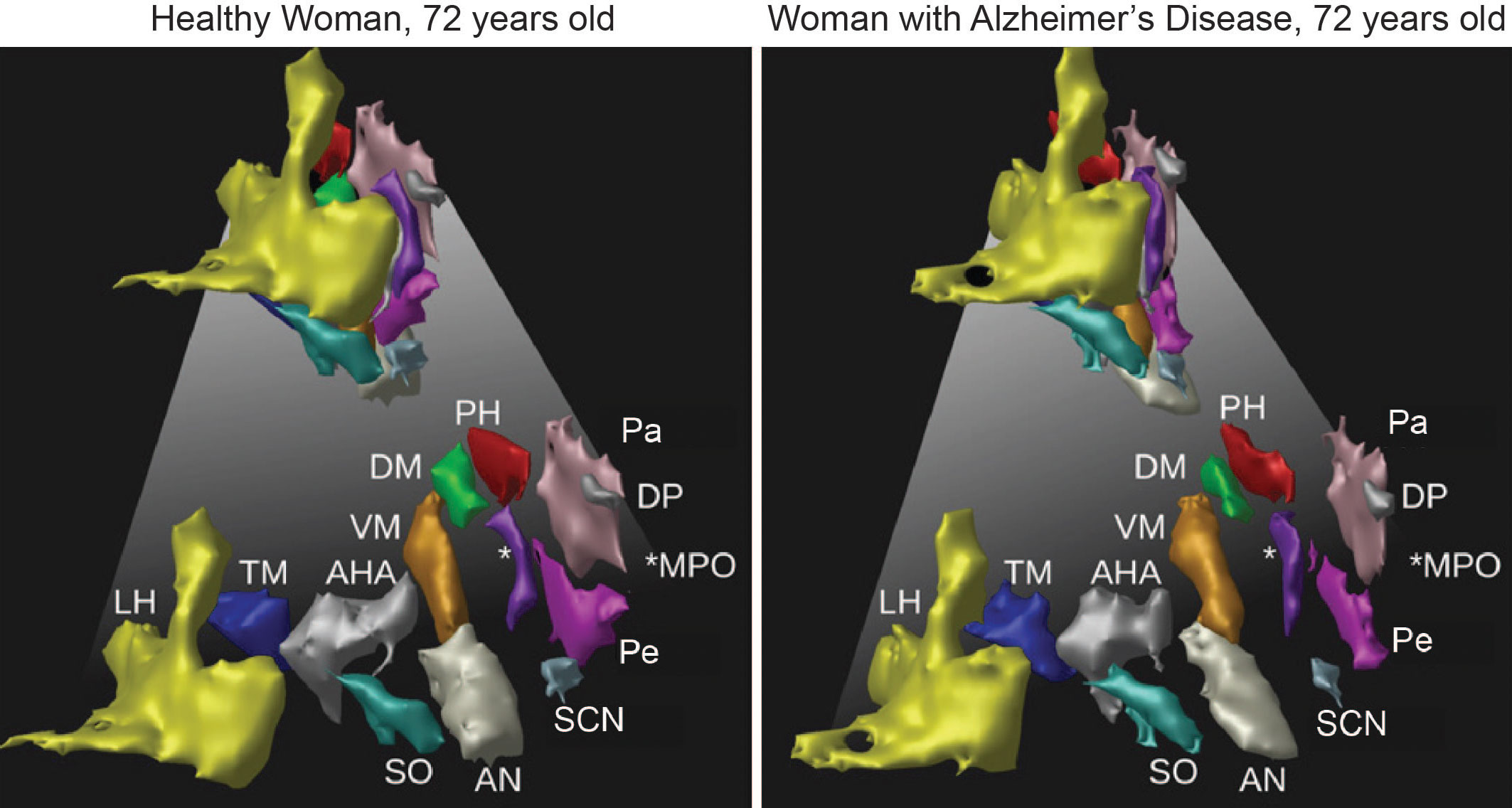
The research, printed November 18, 2026, in Nature, discovered altered exercise within the mind’s clock neurons and immune cells throughout early Alzheimer’s. Researchers additionally found that totally different elements of the hypothalamus change in measurement with regular growing old, even when the area’s total quantity stays comparatively steady.
“Most of what we learn about Alzheimer’s comes from the hippocampus and cortex, as a result of that’s the place reminiscence is organized and lives,” stated senior writer Ashley Webb, PhD, affiliate professor on the Buck Institute for Analysis on Getting older. “However sufferers and households typically report disrupted sleep, a change in urge for food, or totally different responses to emphasize alongside reminiscence adjustments.”
“We wished to look immediately on the a part of the mind that controls these capabilities, and to do it with sufficient decision to see which cells are altering with age and within the illness.”
Alzheimer’s Disrupts the Mind’s Inside Clock
The hypothalamus regulates important capabilities together with physique temperature, starvation, thirst, hormone launch, and sleep. Its specialised areas, known as nuclei, carry out totally different duties. The suprachiasmatic nucleus (SCN) serves because the physique’s grasp clock, coordinating day by day organic rhythms, whereas the arcuate nucleus helps regulate urge for food and vitality steadiness.
Researchers found altered signaling involving vasopressin, a hormone and neuropeptide concerned in circadian regulation, in a outstanding group of SCN neurons. These adjustments may assist clarify why sleep disturbances and irregular day by day rhythms typically accompany Alzheimer’s.
“Sleep and circadian issues are a few of the earliest indicators of Alzheimer’s, and circadian behavioral adjustments referred to as sundowning, happen later within the illness. However we’ve by no means had an excellent molecular rationalization for why,” Webb stated. “Seeing vasopressin signaling disrupted within the mind’s grasp clock, in folks at early levels of the illness, offers us a concrete place to start out.”
Immune Cells Present Early Indicators of Alzheimer’s
The researchers additionally discovered intensive adjustments in microglia, the mind’s resident immune cells. These cells confirmed extra altered genes than another cell kind examined. Computational evaluation prompt a development from a resting state towards the inflammatory, disease-associated state beforehand noticed in different mind areas affected by Alzheimer’s.
“This discovering means that the hypothalamus transitions to an inflammatory state early in Alzheimer’s illness, similar to the mind areas concerned in reminiscence,” stated Webb.
Amongst 254 recognized neuronal subtypes, inhibitory (GABAergic) neurons confirmed notably pronounced adjustments in neuropeptide and receptor signaling. Machine studying fashions may distinguish Alzheimer’s cells from wholesome controls utilizing gene exercise patterns, with irritation and circadian regulation rising as main variations.
Mind Scans Reveal Uneven Adjustments With Getting older
Utilizing MRI scans from 458 dwelling adults, the workforce measured 13 hypothalamic areas. Though the hypothalamus as an entire modified little in quantity with age, particular person areas behaved in a different way. The lateral hypothalamus shrank, whereas the SCN and a number of other areas concerned in metabolism and hormone regulation elevated in measurement.
These patterns remained after accounting for Alzheimer’s standing, suggesting they primarily mirror regular growing old. Quantity variations related particularly with Alzheimer’s weren’t statistically vital.
“When you solely measure the hypothalamus as an entire, it seems to be like nothing is going on,” Webb stated. “While you zoom in, you see some areas shrinking and others rising. That tells us growing old is reshaping this area in a really particular, structured manner.”
The workforce additionally examined gene exercise in roughly 614,000 particular person hypothalamic cells, utilizing tissue from seven folks with principally early-stage Alzheimer’s, seven age-matched controls, and printed knowledge from three youthful people. The mixed findings type HypoAD, a useful resource out there to different researchers.
“No single methodology can reply this query,” stated co-senior writer Manu Goyal, MD, director of neuroimaging labs at Washington College College of Drugs in St. Louis, MO. “MRI can let you know what’s occurring in dwelling folks however is proscribed in its decision. Single-cell sequencing tells you what’s occurring inside every cell kind however requires precise tissue. The objective right here was to place them aspect by aspect to allow us to see issues that neither may present alone.”
What Might Clarify the Adjustments in Mind Measurement?
The researchers discovered no clear proof that whole cell numbers had modified. As an alternative, elevated exercise in mTOR, a pathway that regulates cell development, together with adjustments in surrounding tissue and inflammatory exercise, may assist clarify why sure hypothalamic areas grow to be bigger. This rationalization stays unconfirmed.
The research additionally has limitations. The postmortem Alzheimer’s and age-matched management teams included solely 14 folks, whereas imaging and mobile measurements got here from totally different people. As a result of the analysis didn’t comply with contributors over time, it can’t set up whether or not the noticed adjustments trigger signs or outcome from the illness.
Might the Mind’s Clock Develop into a Therapy Goal?
Future research will examine how these adjustments develop and whether or not defending circadian rhythms and neuropeptide signaling may assist handle signs or gradual Alzheimer’s development. The findings establish potential targets however don’t set up that such interventions would work.
“It is a place to begin, not the ultimate phrase,” Webb stated. “Our subsequent step is to comply with these adjustments over time and check whether or not defending the mind’s clock, and neuropeptide signaling specifically, can gradual the illness or assist handle signs. If circadian disruption is likely one of the first issues to go improper, it might even be one of many first locations we are able to intervene.”
Reference: “Hypothalamic quantity and cell-type adjustments in ageing and Alzheimer’s illness” by Doudou Yu, Jürgen Germann, Ghulam Murtaza, Kaitlyn H. Hajdarovic, Kelsey R. Babcock, Shiva Kazempour Dehkordi, Alexander C. Jackson, Ivana Delalle, Miranda E. Orr, Habil Zare, Ritambhara Singh, Michael J. MacCoss, William Stafford Noble, Andrei G. Vlassenko, Manu S. Goyal and Ashley E. Webb, 18 November 2026, Nature.
DOI: 10.1038/s41586-026-11305-w