


What occurs when a technician is midway by way of a important restore, and the community all of a sudden disappears? The work order received’t load, inspection outcomes can’t be saved, and the job stays open within the system. A misplaced connection can depart a accomplished restore undocumented and create further work for the technician and workplace employees.
An offline subject service app lets technicians entry and replace work orders, seize photographs, and accumulate signatures with out an web connection. It shops info straight on the system and synchronizes it with the central FSM system when connectivity returns.
What Your Enterprise Loses When a Area Service Technician App Goes Offline
Restricted offline performance creates operational issues that reach past a single service go to. When a subject service technician app can’t reliably retailer job knowledge, the implications have an effect on service prices, administrative workloads, billing, and buyer relationships.
The commonest enterprise dangers embody:
- Repeat service visits. Incomplete inspection data or lacking upkeep knowledge might require one other journey to the client web site, growing journey prices and decreasing technician availability.
- Misplaced photographs and signatures. With out dependable native knowledge storage, proof of accomplished repairs, gear circumstances, or buyer approval might disappear earlier than reaching the central system.
- Guide knowledge entry. Technicians might depend on paper types or separate notes, leaving workplace employees to switch info into the FSM system. This provides administrative work and will increase the danger of errors.
- Delayed invoicing. Lacking completion stories and repair confirmations can forestall billing groups from processing invoices promptly, affecting money stream.
- Buyer disputes. Incomplete service histories make it more durable to confirm accomplished work, justify expenses, or resolve disagreements over service high quality.
These dangers needs to be thought of when evaluating cellular subject service administration software program. Past supporting every day subject operations, the appliance must protect correct service data and preserve a dependable stream of knowledge between technicians and workplace groups.
Offline-Succesful vs Offline-First: 4 Ranges of Offline Help
Offline assist varies significantly between subject service functions. To check options, companies can consider 4 widespread functionality ranges, from fundamental entry to cached data to offline-first workflows with automated synchronization and battle dealing with.
| Degree | What It Helps | Enterprise Threat |
| 1. View-only cache | Technicians can view beforehand downloaded duties and gear particulars however can’t save adjustments. | Work should be documented later, growing administrative effort and the danger of lacking info. |
| 2. Offline types | Technicians can full types with out connectivity, however unsaved drafts might disappear when the app closes. | Interrupted periods may end up in misplaced inspection knowledge and repeated work. |
| 3. Full native write | Work orders, photographs, and updates are saved on the system, however technicians should manually provoke synchronization. | Forgotten uploads can delay reporting, billing, and workplace workflows. |
| 4. Offline-first with sync queue | The app saves adjustments regionally and mechanically synchronizes them when connectivity returns, with safeguards in opposition to duplicates and conflicting updates. | Poorly designed synchronization can nonetheless produce inconsistent data or require guide battle decision. |
When evaluating FSM distributors or improvement companions, ask which degree their answer really helps. Request an indication protecting community loss, app restarts, duplicate submissions, and conflicting updates. A working offline mode needs to be verified by way of actual subject eventualities, not function descriptions alone.
Off-the-Shelf Offline Mode vs Customized: When Constructed-In Isn’t Sufficient
Many FSM platforms already embody a subject service app with offline mode, so constructing a customized offline subject service app isn’t at all times crucial. The choice is determined by whether or not built-in performance covers your subject workflows, knowledge necessities, and connectivity circumstances.
What Do Present FSM Platforms Provide?
Microsoft Dynamics 365 Area Service helps offline-first cellular operations by way of configurable cellular offline profiles. Directors outline which data are downloaded and out there offline, together with synchronization settings. Information outdoors the downloaded profile might require connectivity, whereas sure network-dependent options stay unavailable offline.
Salesforce Area Service helps offline knowledge entry by way of Briefcase configurations, however sure options have documented limitations. For instance, some knowledge sorts and Lightning Internet Element behaviors require extra consideration when planning offline workflows.
When Is Constructed-In Offline Mode Sufficient?
Commonplace performance could also be enough when technicians observe typical work-order processes, work with out connectivity for comparatively brief intervals, and want solely the info supported by the configured offline profile. Earlier than investing in improvement, take a look at your precise workflows with the prevailing platform.
When Ought to You Think about Customized Growth?
A customized software turns into extra related when your online business requires:
- Prolonged offline operations: Crews work for days or perhaps weeks with out dependable connectivity.
- BLE or IoT integration: Technicians alternate knowledge straight with gear and sensors.
- Giant native datasets: Groups want offline maps, technical drawings, images, or intensive asset documentation.
- Customized battle decision: A number of technicians and dispatchers replace the identical data underneath particular enterprise guidelines.
- Specialised workflows: Inspections contain industry-specific types, calculations, approvals, or compliance checks.
- SaaS product differentiation: Your cellular software should assist customer-specific processes as a part of your FSM providing.
Is There a Center Floor?
Sure. As a substitute of changing your FSM platform, you possibly can develop a customized cellular frontend linked to the prevailing FSM, CRM, or ERP by way of out there integration interfaces.
This method preserves established back-office processes whereas supplying you with extra management over offline workflows, native storage, and synchronization. Integration capabilities and upkeep prices nonetheless want evaluation.
In case your crews commonly hit the bounds of built-in offline mode, SCAND can develop a subject service app that works offline whereas retaining your current FSM platform because the central system for managing service operations.
5 Offline-First App Structure Choices That Drive Price and Threat
An offline-first cellular app’s structure determines how a lot knowledge technicians can entry, what occurs to unsent adjustments, and the way the system recovers after connectivity returns. These selections straight have an effect on improvement prices, testing effort, and the danger of dropping subject data.
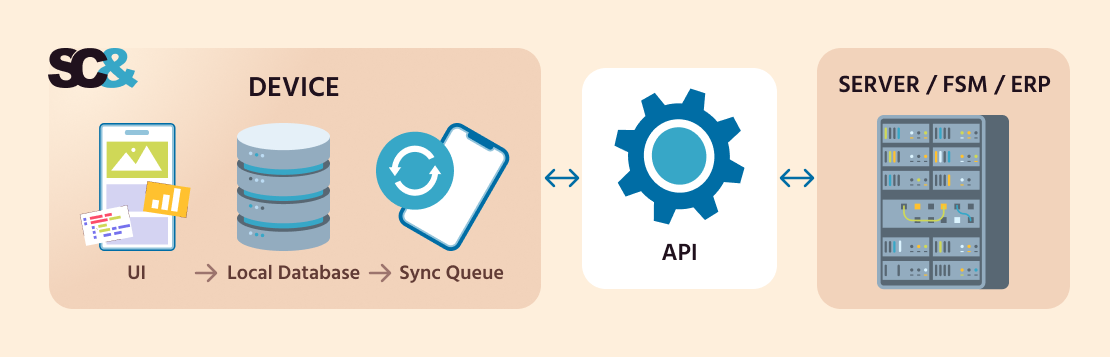
How Lengthy Do Crews Must Work With no Sign?
An app designed for a two-hour community outage wants a special method from one utilized by crews working offline for per week. Longer offline intervals imply extra native storage, bigger datasets, and extra advanced synchronization. The enterprise ought to outline the utmost anticipated time with out connectivity upfront, as a result of underestimating it results in pricey rework as soon as the app reaches actual subject circumstances.
What Information Lives on the Machine
Does each technician want the complete asset historical past, or solely in the present day’s duties? Native knowledge might embody work orders, checklists, maps, and gear documentation, preloaded over Wi-Fi to cut back cellular knowledge prices. Storing solely what every function wants additionally limits safety publicity, storage use, and synchronization time.
Who Wins in a Information Battle
A technician edits a piece order offline whereas a dispatcher updates it within the workplace. Which model ought to the system maintain? Accepting each server replace might erase subject observations, whereas accepting each technician replace might overwrite revised assignments.
Guidelines ought to replicate enterprise priorities: advanced guidelines require extra improvement and testing however can scale back the danger of conflicting data. Three widespread methods are in contrast beneath.
| Technique | Typical Information | Enterprise Consideration |
| Server wins | Work order standing, assignments | Central adjustments take precedence; subject updates may have assessment |
| Area-level merge | Notes, particular person line objects | Preserves unbiased adjustments however requires field-specific guidelines |
| Guide assessment | Fees, signatures, disputed data | Protects delicate data however provides administrative work |
“Offline operations additionally have an effect on how managers interpret service efficiency. A job accomplished at 2 PM may not attain the FSM system till the following morning. If reporting depends solely on synchronization timestamps, completion occasions and technician productiveness metrics could be deceptive. The system wants to differentiate when work occurred from when the info arrived.”
— Vitaly Tormanov, Head of Cellular Options at SCAND
Photographs, Signatures, and Heavy Information
Photographs, drawings, and signed paperwork require significantly extra storage and bandwidth than textual content. A separate file queue lets the app ship important textual content updates first and compressed attachments afterward. The enterprise additionally decides which recordsdata want authentic high quality and the way failed uploads are retried, which impacts infrastructure prices and the reliability of service data.

Safety of Offline Information
Enterprise knowledge stays on technicians’ units, generally for lengthy intervals. Key selections embody system encryption, distant wipe when a telephone is misplaced, and the way lengthy customers can keep signed in with out reconnecting. Stricter controls elevate implementation and system administration prices, however weak ones can expose buyer and infrastructure data.
The cellular expertise stack additionally impacts native storage choices, improvement effort, and upkeep prices:
| Expertise | When to Select It | Native Storage Choices |
| Native Android / iOS | Deep system integration, demanding subject workflows | Room (Android), Core Information (iOS) |
| Flutter | Offline-first apps for Android and iOS with substantial offline performance | Drift, ObjectBox |
| React Native | Cross-platform apps with current JavaScript/React experience | WatermelonDB |
| PWA (offline-first net app) | Light-weight workflows accessible by way of a browser | IndexedDB |
An offline-first net app faces iOS limits on storage and background synchronization, so native or cross-platform apps normally go well with crews that rely upon offline work.
AI in an Offline Area Service App: What Runs on the Machine and What Waits for Sync
AI may help technicians doc repairs, establish gear, and put together stories even with out web entry. Nonetheless, an offline subject service app should distinguish between duties that may run regionally and people requiring cloud processing. This alternative impacts system necessities, improvement prices, and reliability.
What AI Options Can Work Offline?
With appropriate on-device fashions, technicians can:
- Convert voice notes into textual content with out typing inspection particulars.
- Extract serial numbers and gear labels from images utilizing optical character recognition (OCR).
- Draft service stories from regionally saved notes and job particulars.
- Recommend guidelines steps primarily based on out there gear info and inspection outcomes.
Apple’s Basis Fashions framework helps on-device language processing on suitable Apple Intelligence units operating iOS 26 or later. Google’s ML Equipment GenAI APIs use Gemini Nano for duties similar to summarization, proofreading, rewriting, and picture description on supported Android units.
What AI Duties Ought to Await Connectivity?
Extra computationally demanding duties, similar to detailed injury evaluation, dispatch optimization, and insurance coverage report era, could also be higher dealt with within the cloud, relying on the out there units and AI fashions.

SCAND labored on TreeNinjaAI, an AI-powered storm restoration platform, that includes photo-based injury classification, preliminary work estimates, and insurance coverage reporting diminished from days to minutes.
What Ought to Companies Think about?
Earlier than investing in offline AI, consider:
- Machine compatibility: Present technician telephones might not assist the required fashions.
- Human assessment: Technicians ought to affirm AI-generated findings earlier than saving them.
- Battery and storage: Native inference and downloaded fashions improve system useful resource necessities.
For added use circumstances, see how AI in subject service administration helps service operations past offline workflows.
How you can Check a Area Service Technician App Offline Earlier than You Signal Off
A subject service technician app might carry out effectively in a demo on secure Wi-Fi however behave in a different way on a distant job web site. Earlier than approving a vendor’s answer or accepting a customized software, take a look at the way it handles interruptions, unsent knowledge, and conflicting updates.
Six Offline Check Eventualities
Run these eventualities throughout acceptance testing and verify every outcome in opposition to the go criterion.
| Situation | What to Do | Go If |
| Interrupted kind | Allow airplane mode midway by way of an inspection, then restart the app | All entered knowledge continues to be there |
| 1–3 days offline | Create and replace a number of work orders, then reconnect | All the pieces syncs with no duplicate data |
| Similar file edited twice | Have a technician and a dispatcher change one work order independently | The agreed battle rule is utilized |
| 50+ photographs offline | Seize the photographs, then reconnect | All recordsdata add, and textual content updates sync first |
| Weak connection | Check with unstable, low-speed connectivity | Failed uploads are retried with out creating duplicate data |
| Sync standing | Verify what technicians see on display screen | Adjustments are clearly proven as saved, pending, or synced |
Questions for the Vendor or Growth Associate
Ask these questions alongside the assessments:
- How are conflicting updates detected and resolved?
- The place is offline knowledge saved, and the way is it encrypted?
- What occurs to unsent data if the app is reinstalled?
- How are failed synchronization makes an attempt tracked and retried?
- Can directors monitor synchronization failures throughout technicians’ units?
Request an indication of those eventualities earlier than signing off. A profitable take a look at ought to affirm that data stay correct and recoverable even when connectivity is unreliable.
How SCAND Builds Offline-First Area Apps
Constructing an offline subject service administration app requires sensible expertise with unreliable connectivity, native knowledge storage, and synchronization. SCAND has labored on these challenges throughout agriculture and subject service tasks. With 25+ years in software program improvement, 250+ engineers, and 900+ accomplished tasks, our group develops cellular options for demanding subject environments.
Soil Sampling App: Dependable Information Assortment in Distant Fields
An agricultural firm wanted a cellular app for operators gathering soil samples in areas with weak or unavailable mobile protection. The answer additionally needed to talk with specialised sampling gear and scale back errors in recording pattern places.
SCAND developed a cross-platform soil sampling app utilizing Flutter, ObjectBox for native storage, and background synchronization by way of a safe API. Bluetooth Low Power (BLE) linked the appliance to sampling gear.
The outcome: AI-assisted route planning and optimized subject zoning diminished operator journey time, making subject operations as much as 25% sooner. Automated GPS monitoring additionally helped get rid of guide coordinate entry errors. Collected knowledge remained out there offline and synchronized when connectivity returned.
Area Service Cellular App: Versatile Workflows On-line and Offline
One other shopper wanted a cellular answer for coordinating subject technicians, managing service duties, and gathering stories throughout totally different enterprise actions. Customizable types and dependable offline knowledge processing had been central necessities.
SCAND constructed a subject service cellular app that includes on-line and offline knowledge processing, sensible synchronization of data and maps, encrypted native caching, dynamic types, and digital signatures.
The outcome: The appliance diminished time spent organizing and getting ready service duties and improved operational visibility. Versatile types supported work orders, stories, invoices, and different service processes.
Often Requested Questions (FAQs)
Which subject Service apps supply offline performance?
Microsoft Dynamics 365 Area Service, Salesforce Area Service, and different FSM platforms assist offline operations to various levels. Obtainable options rely upon knowledge configuration, synchronization settings, and platform limitations. For groups working offline for prolonged intervals or following specialised workflows, a customized cellular software could also be a greater match.
What occurs to a technician’s work if the sign drops mid-job?
In a correctly designed offline-first app, technicians can proceed working as a result of adjustments are saved straight on the system. Work orders, inspection outcomes, photographs, and signatures stay out there with out connectivity. As soon as the connection returns, the appliance synchronizes pending updates with the central system, permitting workplace groups to entry accomplished data.
How lengthy can technicians work offline?
There isn’t any common restrict. Some functions assist brief interruptions, whereas others are designed for a number of days or perhaps weeks with out connectivity. The sensible length is determined by native storage capability, out there work-order knowledge, system sources, and synchronization design. Companies ought to outline the longest anticipated offline interval earlier than improvement begins.
Are you able to add offline mode to our current subject service app?
Sure, in lots of circumstances. Builders can add native knowledge storage, offline workflows, and synchronization to an current cellular software. The trouble is determined by its present structure, backend APIs, and knowledge dependencies. If main adjustments are required, constructing a brand new cellular frontend linked to the prevailing FSM platform could also be extra sensible.
How do you forestall knowledge conflicts between technicians and dispatchers?
Battle decision begins with defining which adjustments take precedence. Central assignments might observe server-side guidelines, whereas unbiased notes could be merged. Delicate data, similar to expenses or signatures, might require guide assessment. The appliance detects conflicting updates throughout synchronization and applies predefined guidelines to stop unintended overwrites.
Can AI options work in an offline subject service app?
Sure, partly. Speech-to-text, picture textual content recognition, and report summaries can run offline utilizing on-device AI, similar to Apple Basis Fashions or Gemini Nano, on supported units. Extra demanding duties, together with injury evaluation and sensible dispatching, require cloud processing as soon as connectivity returns. Machine compatibility needs to be checked earlier than implementation.

