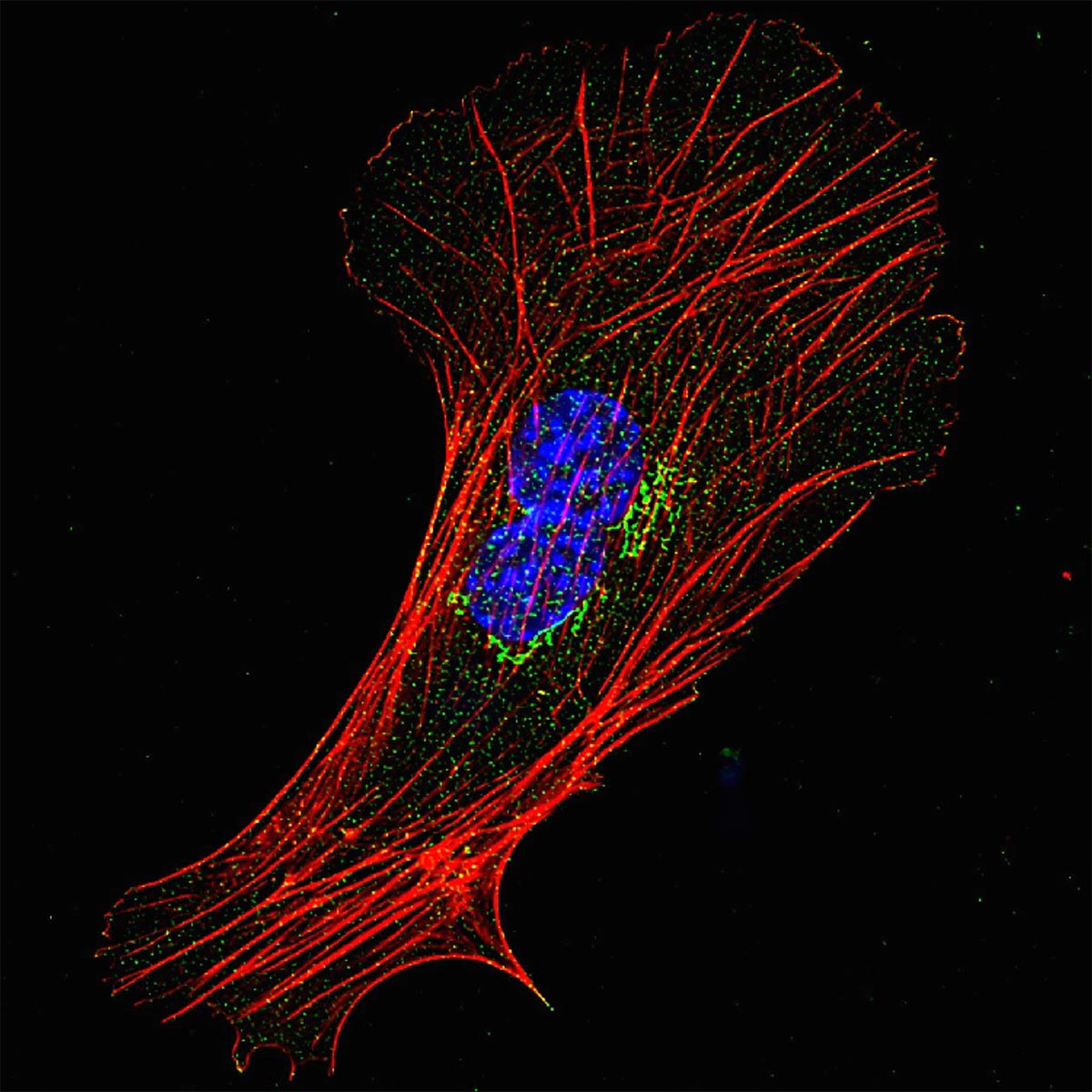


The instruments scientists use to check cells could also be altering the very proteins they observe, elevating questions on many years of analysis into how cells keep their construction.
For many years, textbooks and a whole lot of scientific papers have described coronin proteins as essential organizers of the interior framework that offers cells their form and helps them transfer. Now, researchers on the College of Basel in Switzerland are revisiting that longstanding clarification, exhibiting how scientific progress can typically start by questioning what we thought we already knew.
Coronins are present in organisms starting from single-celled amoebae to people. They’re concerned in important processes similar to immunity, growth, and cell survival. Scientists have historically seen them as proteins that work together with actin, a significant part of the cytoskeleton. This community of tiny filaments helps a cell’s construction, permits it to maneuver, and helps arrange its contents.
Coronins might play a unique position in cells
A brand new research printed in PLOS Biology, led by Professor Jean Pieters on the College of Basel’s Biozentrum, challenges that understanding. Utilizing a broad vary of experiments to look at coronins of their pure state, the researchers discovered that these proteins are largely pointless for the general group of the actin cytoskeleton.
“Over time, my laboratory failed to search out proof for a direct position of coronin proteins in actin binding and modulation throughout a variety of mannequin techniques,” says Pieters. “Even cells missing coronins proceed to arrange and rework their actin networks usually. After all, absence of proof is just not proof of absence.”
Laboratory instruments might have distorted outcomes
The group additionally recognized a potential purpose why earlier research reached completely different conclusions. To look at proteins inside residing cells, scientists typically connect molecular tags that make them simpler to trace. Though these instruments are extensively used, they’ll typically intrude with the proteins being studied.
“These tags are extraordinarily helpful and assumed to be innocuous for protein perform,” says Roko Gvozdenica, the research’s first writer. “Nevertheless, we discovered that the tagging of coronin proteins has the potential to trigger lack of their perform and considerably alter their localization.”
This raises the chance that some earlier proof linking coronins to actin resulted from experimental artifacts reasonably than their pure habits. The researchers additionally discovered that many antibodies used to detect coronins lack specificity, including to broader issues concerning the reliability of those instruments in biomedical analysis.
Coronins assist keep wholesome immune cell numbers
The findings deliver consideration to a different essential position of coronins: serving to cells talk by chemical indicators.
“Over time, we have now reported that coronins are concerned in cell signaling,” emphasizes Pieters. “Within the immune system, for instance, coronin involvement in these signaling processes was discovered to be important for the upkeep of regular T cell numbers, which is significant for safeguarding the physique in opposition to infections or most cancers.”
The researchers warning that their findings don’t utterly rule out a connection between coronins and the cytoskeleton. These proteins should still affect its group, both straight or not directly by cell signaling.
By reexamining an concept that has formed analysis for many years, the research opens new prospects for understanding how coronins assist cells talk, survive, and keep wholesome cell numbers.
Reference: “Reassessment of the roles of coronin proteins as actin effectors and in signaling” by Roko Gvozdenica Šipić, Haiyan Zhang, Andrii Kharin, Jerneja Koren, Viviana D’Otolo, Yuko Nariai, Takeshi Urano, Pawel Pelczar, Klemens Fröhlich, Alexander Schmidt, Urszula Brykczynska Kunzmann, Tohnyui Ndinyanka Fabrice, Alexey Baldin and Jean Pieters, 18 August 2026, PLOS Biology.
DOI: 10.1371/journal.pbio.3003904