

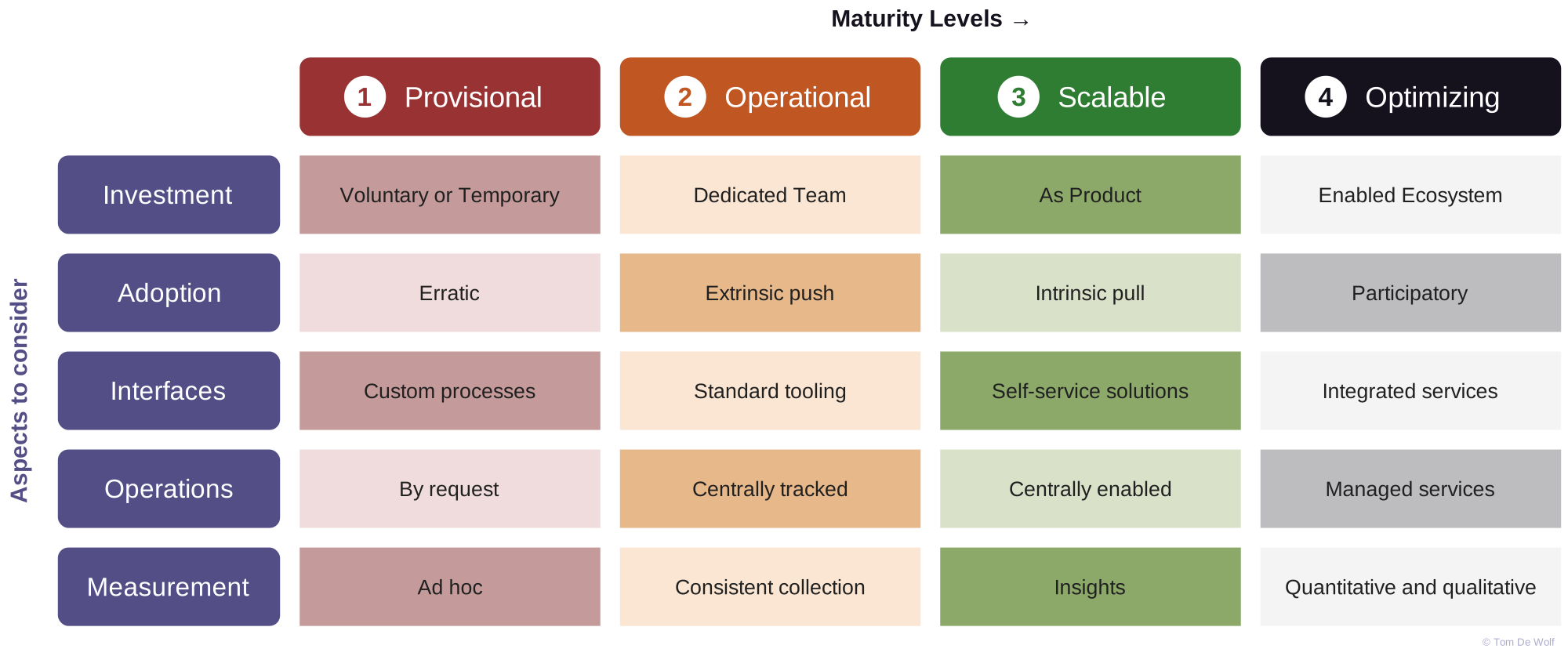
The 4 Ranges of Platform Maturity for Information Merchandise and Information Mesh
Stage 1: Provisional Platform – The “No Platform” Platform
A provisional platform for information merchandise and information mesh is characterised
by an ad-hoc and chaotic strategy to know-how and provisioning. To
illustrate this, let’s use a little bit of area storytelling.
Determine 7: Area storytelling
for a provisional platform, displaying builders making ad-hoc requests to
completely different engineers for varied elements, resulting in a chaotic mixture of
applied sciences.
Contemplate a primary information product developer who units out to create a brand new
information product. Missing a central self-service platform, they need to navigate
the group by private networks. They begin by speaking to a
DevOps engineer [1] to request a supply management repository, and that
engineer creates a Git repository [2] on the Git platform. Subsequent, the
developer wants a construct and deployment automation pipeline, in order that they discuss
to a second DevOps engineer [3], who creates a CI pipeline [4] on the CI
system. For information storage, the developer talks to a cloud engineer [5], who
creates an S3 bucket [6] on AWS Cloud. With the essential infrastructure in
place, the developer units up their very own information processing instruments: they create
an Iceberg database [7] on an Iceberg catalog and question engine, and create
a Spark job [8] working on a Spark cluster. By manually assembling these
disparate items, they produce one thing that resembles a knowledge
product.
Someday later, a second information product developer is tasked with constructing
one other information product. Having no platform documentation or self-service
interface to information them, they discuss to the primary developer [9] to ask how
to get began. The primary developer refers them to the DevOps engineer who
helped them earlier. The second developer then talks to that very same DevOps
engineer [10], who creates one other Git repository [11] on the Git
platform. Subsequent, the developer talks to the second DevOps engineer [12],
who creates one other CI pipeline [13] on the CI system.
When selecting their analytical know-how stack, nevertheless, the second
developer takes a completely completely different course. Fairly than utilizing Iceberg
and Spark, they create a dataset [14] on Google BigQuery, run a dbt mannequin
[15] on dbt Cloud for transformations, and create a view [16] on a knowledge
virtualization device to serve the info.
This situation highlights the core failure modes of a provisional
platform. Information know-how is requested and provisioned solely ad-hoc,
with human bottlenecks at each step the place builders should “know somebody
who is aware of somebody that is aware of easy methods to do one thing” to make progress. There
is not any specific idea of a knowledge product or information contract. There are solely
remoted, manually stitched items of technical infrastructure. The consequence
is simply too excessive a cognitive load, deep technological fragmentation and
complexity, and growing shadow IT throughout the group.
Stage 2: Operational Platform – The “Fragmented” Platform Expertise
On the operational degree, there’s an effort to standardize know-how
and monitor requests centrally. Nonetheless, the expertise for information product
builders stays fragmented and complicated.
To introduce order into the chaos, organizations sometimes set up
devoted infrastructure groups (e.g. a DevOps Crew, a Cloud Crew, and a
Information Platform Crew). Requests are then channeled by a centralized
ticketing system like Jira.
Determine 8: Area storytelling
for an operational platform, displaying builders utilizing a ticketing system,
however nonetheless having to manually glue the elements collectively.
Persevering with the story, the info product developer now has to request
each element by formal tickets:
The developer creates a Git Repository Ticket [1] within the ticketing
system. Someday later, the DevOps Crew reads the ticket [2] and
provisions a Git repository [3] on the Git platform. The developer then
creates a CI Pipeline Ticket [4], which the DevOps Crew reads [5] to
provision a CI pipeline [6] on the CI System. For storage, the developer
creates an S3 Bucket Ticket [7], which the Cloud Crew reads [8] to
provision an S3 bucket [9] on AWS Cloud. Turning to information infrastructure,
the developer creates an Iceberg Database Ticket [10], which the Information
Platform Crew reads [11] to provision an Iceberg database [12] on the
Iceberg Catalog & Question Engine. Lastly, the developer creates a Spark Job
Ticket [13], which the Information Platform Crew reads [14] to provision a Spark
job [15] on the Spark Cluster.
Whereas this introduces central visibility and standardizes the
know-how catalog, it replaces private tapping-on-shoulders with queues
and handoffs. Ready for a number of groups to meet tickets takes
vital time. Extra critically, as soon as all these particular person elements
are provisioned, the developer remains to be left solely alone to attach them
collectively right into a functioning information product. Pissed off by the delays and
integration friction, builders are sometimes tempted to bypass the platform
altogether, managing [16] their very own shadow IT answer (“My Information
Platform”) to ship outcomes quicker.
On the operational degree, automation will be launched by typical
Infrastructure-as-Code (IaC) scripts (e.g. Terraform) to hurry up the
provisioning of particular person elements. This can keep away from ticketing methods
and human bottlenecks.
Determine 9: Area
storytelling for an operational platform, displaying builders utilizing restricted
Infrastructure-as-Code automation, however nonetheless having to manually glue the
elements collectively.
On this different setup, every
specialised workforce supplies reusable scripts that builders can execute
independently. The information product developer executes the
createGitRepository script [1], which robotically
provisions a Git repository [2] on Git. The developer then executes the
createCIPipeline script [3], which provisions a CI pipeline
[4] on the CI System. For cloud storage, the developer executes the
createS3Bucket script [5], provisioning an S3 bucket [6] on
AWS Cloud. For information property, the developer executes the
createIcebergDatabase script [7], provisioning an Iceberg
database [8] on the Iceberg Catalog & Question Engine, and executes the
createSparkJob script [9], provisioning a Spark job [10] on
the Spark Cluster.
Whereas this script-based automation eliminates ticketing delays, the
developer remains to be left with the advanced process of gluing every little thing
collectively to create a knowledge product. The cognitive load stays excessive, and
there’s a information bottleneck, as builders have to know easy methods to compose
information merchandise from these completely different elements (e.g. configure and
combine networking, safety roles, storage, pipelines, secrets and techniques, and many others).
When errors happen, builders run into information gaps and nonetheless want [11]
direct human assist from the DevOps Crew, Cloud Crew, and Information Platform
Crew.
Finally, this operational strategy results in a scarcity of uniformity:
organizations find yourself with “Frankenstein” information merchandise that look related
on the floor as a result of they use the identical underlying applied sciences, however are
architecturally inconsistent underneath the hood. Exhausted by the complexity
of sewing every little thing collectively, builders often retreat to shadow
IT, persevering with to handle [12] their very own native platforms (“My Information
Platform”).
Stage 3: Scalable Platform – Platform as a Product
A scalable information mesh platform represents a significant shift within the
developer expertise. The interface adjustments fully, transferring from
particular person applied sciences to a higher-level, information product-centric
abstraction.
Determine 10: Area storytelling for a
scalable platform, displaying a developer interacting with a self-service
portal that handles the provisioning and integration of information
merchandise.
On this situation, the group establishes a
devoted Information Product & Information Mesh Platform Crew that treats the
platform as a product. Fairly than dealing with tickets or offering
disconnected scripts, this workforce supplies a self-service developer
expertise consisting of a Information Product Developer Portal and an underlying
Information Mesh Platform Backend.
The area
story is way less complicated. In abstract, a knowledge product developer simply clicks
‘Create Information Product’, and the platform wires the know-how and
infrastructure collectively as a Information Product. Within the area storytelling
diagram above, the developer creates a Information Product [1] on the Information
Product Developer Portal by defining its architectural specification
comparable to enter and output ports, information transformation code setup, and information
contracts for the construction and ensures on the info. The portal
captures this intent and instructs the Information Mesh Platform Backend to do
the provisioning and integration of elements.
From this single
declaration, the Information Mesh Platform Backend robotically orchestrates
the underlying technical assets throughout all infrastructure domains: it
provisions a Git repository [2] on Git, provisions a CI pipeline [3] on
the CI System, and provisions an S3 bucket [4] on AWS Cloud. Within the information
infrastructure area, the backend provisions an Iceberg database [5] on
the Iceberg Catalog & Question Engine, and provisions a Spark job [6] on
the Spark Cluster.
As an alternative of simply spinning up remoted elements, the backend
robotically wires and glues them collectively right into a cohesive,
standardized information product.
This built-in self-service tooling transforms the developer
expertise. The cognitive load on builders drops considerably as a result of
they work together with the abstraction of a knowledge product quite than
wrestling with underlying applied sciences. It removes the information
bottleneck: builders now not have to be infrastructure plumbing
specialists who know easy methods to hand-stitch safety permissions, pipelines, and
storage configurations. Moreover, as a result of the platform backend
enforces architectural requirements, each information product displays extra
technical uniformity, which prevents “Frankenstein” information merchandise. When
each information product adheres to the identical standardized architectural
construction, the platform can allow automated governance by injecting
automated coverage checks, audit logging, entry controls, and information high quality
verification throughout all information merchandise. By making information product creation
straightforward, easy and frictionless, it encourages voluntary
adoption, naturally discouraging shadow IT.
By eradicating the information bottleneck, the platform empowers information
product builders with extra autonomy, which is essential for scaling a
information mesh and information product administration observe throughout a number of area
groups.
Stage 4: Optimizing Platform – Platform as an Ecosystem
On the optimizing degree, the platform turns into deeply built-in
into the every day developer workflow. Fairly than requiring builders to
swap contexts and go to a platform portal, the platform comes
on to the developer’s working surroundings and context.
Determine 11: Area storytelling for
an optimizing platform, displaying the platform built-in into the
developer’s native surroundings IDE/CLI and an ecosystem of groups
contributing to the platform.
This shift is achieved within the developer’s native context by making
the instruments they dwell in each day (e.g. IDE or CLI) “information product
conscious.” The area story illustrates how this streamlines all the
information product lifecycle:
The information product developer creates [1] a neighborhood Information Product
straight from their day-to-day workspace. By means of an IDE Plugin or a
devoted CLI, the developer can create, develop, deploy, and monitor
the info merchandise from inside their acquainted surroundings with out
disruptive context switching.
The native instruments talk with the platform and create [2] the
Information Product on the centralized Information Mesh Platform Backend (which is
maintained by the Information Mesh Platform Crew).
From there, the
Information Mesh Platform Backend robotically provisions and integrates the
vital applied sciences wanted for the info product. A Git Repository
is provisioned on Git [3] and a CI Pipeline on the CI System [4]. In
AWS Cloud, an S3 Bucket is created [5] to retailer information within the information
product. Construction is given to the info utilizing an Iceberg Database [6]
on an Iceberg Catalog & Question Engine. And eventually, the info product
comes alive when a Spark Job is working within the Spark Cluster [7].
Simply as in Stage 3, the platform backend robotically handles all
the wiring and integration so the provisioned assets are glued
collectively to operate as a single, cohesive information product.
One other defining dimension of the optimizing degree is the emergence
of a federated platform ecosystem. The central platform workforce now not
acts as a bottleneck for brand new capabilities. As an alternative, different groups throughout
the group can contribute on to the platform backend:
- An engineer from a Area Crew can contribute a domain-specific extension,
comparable to Platform Functionality X (e.g. specialised information product templates), making
it obtainable to all the group [8]. - An engineer from a Specialised Crew (comparable to safety, compliance, or information
governance) can contribute platform capabilities, comparable to Platform Functionality Y
(e.g. automated PII masking, fine-grained entry insurance policies, or audit logging)
[9].
An optimizing platform for information merchandise and information mesh minimizes
context switching for builders, manages all the information product
lifecycle, and allows an ecosystem of contributors. Managing the
total information product lifecycle empowers the group to execute
migrations of information merchandise when underlying applied sciences evolve (e.g.
upgrading an Iceberg or Spark model, breaking adjustments in information
contract codecs, and many others), with out requiring each workforce to rewrite their
information merchandise. Actively monitoring which platform capabilities and which
information merchandise are literally consumed permits groups to prune unused information
merchandise and decommission out of date platform options, frequently
refining and evolving the platform to fulfill organizational wants.
Minimal Maturity Stage for Information Mesh Success
Given these completely different ranges of maturity, what’s the minimal
degree required for a profitable information mesh implementation?
Determine 12: Minimal maturity ranges for
Information Mesh success, highlighting the Scalable degree because the minimal
requirement.
The provisional degree is basically chaos. There isn’t a actual
platform, and area groups are left ready for assets or
constructing their very own options. It is not possible to construct a
decentralized, interoperable mesh with disconnected and unmanaged
instruments.
The operational degree, whereas extra organized, nonetheless presents
vital challenges. The excessive cognitive load and fragmented developer
expertise imply that groups are nonetheless accountable for gluing the items
collectively themselves. This can be a widespread entice for organizations that concentrate on
automating the provisioning of particular person applied sciences with out addressing
the general developer expertise. The complexity and friction usually lead
to low adoption charges and a continuation of shadow IT. After having
invested solely in standardizing and automating particular person applied sciences,
many information mesh journeys get caught at this degree, as a result of it’s too advanced
and dear for area groups to take part.
This brings us to the scalable platform for information merchandise and information
mesh. That is the minimal degree for achievement. At this stage, the platform
workforce transitions from an IT helpdesk to a product workforce centered on
developer expertise and bridging the platform hole. By permitting builders
to work together with the abstraction of a knowledge product, the platform removes
the complexity of the underlying applied sciences, encouraging voluntary
adoption and enabling the decentralized possession that’s on the coronary heart of
information mesh.
Conclusion
Constructing a self-service platform for information merchandise and information mesh requires
balancing completely different elements. On a technical degree the platform ought to
decrease cognitive load considerably and be as easy-to-use as doable. On the
identical time it isn’t a purely technical mission, as a result of we wish individuals to
undertake the platform with out pushing them to take action.
By utilizing the Platform Engineering Maturity Mannequin as our navigator, we are able to
assess the place our platform stands at the moment, uncover the elements inflicting essentially the most
friction, plan small steps for enchancment, and iterate on this. The mannequin
permits us to clarify our progress, what priorities we need to put money into,
and the worth of our investments to stakeholders to get buy-in and
funding.
In case you are questioning the place to start by yourself journey, begin small: deliver
this maturity mannequin to your subsequent platform or structure dialogue. Map
the place your capabilities sit at the moment, establish the one space creating the
most friction to your area groups, and focus your subsequent funding cycle
proper there.
The tip objective is to bridge the platform hole and transfer from a fragmented and
mandated toolchain to a knowledge product and user-centric self-service platform
that really empowers groups to succeed with information mesh, information merchandise and information
contracts.

